

Managing people is just as important as managing work. For project managers and team leaders using Jira, one of the most common blind spots is leave and absence management. When team availability is unclear, sprint commitments become risky, deadlines slip, and delivery confidence suffers.
While Jira excels at tracking tasks, workflows, and progress, it does not provide a built-in way to manage employee leave. This gap has led many teams to rely on spreadsheets, shared calendars, or informal messages—solutions that don’t scale and often fail when planning matters most.
Fortunately, the Atlassian Marketplace offers several leave management apps designed specifically for Jira users. In this article, we’ll explore the best Jira leave management solutions, evaluate them from a resource and team management perspective, and help you choose the right option for your team.
Why choose a Jira leave management app from the marketplace?
Jira does not include native functionality for requesting, approving, or tracking leave. There is no standard way to see who is on vacation, sick leave, or otherwise unavailable during a sprint. As a result, most teams manage absences outside Jira, which creates several challenges:
- Team availability is disconnected from sprint planning
- Project managers lack a reliable view of capacity
- Leave approvals and records are scattered across tools
- Last-minute absences can disrupt delivery plans
Atlassian Marketplace apps are designed to close this gap by extending Jira with dedicated leave and absence management capabilities, all within the same environment your teams already use.
Read more: How to overcome challenges in Jira leave management with TimePlanner.
Here are several key advantages that marketplace leave management apps offer:
- Native Jira integration: Leave requests, approvals, and calendars live directly in Jira, reducing context switching and manual updates.
- Improved transparency: Team members, scrum masters, and managers can clearly see availability, making planning more predictable.
- Better sprint and resource planning: Planned absences can be factored into sprint commitments, helping teams avoid over-allocation.
- Automation and consistency: Approval workflows, leave policies, and holiday rules are standardized instead of handled informally.
- Scalability: Marketplace apps support growing teams and organizations across Jira Cloud and Data Center.
For agile teams that depend on realistic planning and predictable delivery, managing leave inside Jira is no longer optional—it’s essential.
5 best Jira leave management solutions for agile teams
Now, let’s take a closer look at the 5 best solutions for managing leaves that you can get from the Atlassian marketplace.
1. TimePlanner by DevSamurai
Teamboard TimePlanner is a high-utility resource management suite that treats leave as a critical variable in your project’s financial and operational success. It is one of the Jira leave management solutions designed to bridge the gap between human absence and project deadlines.
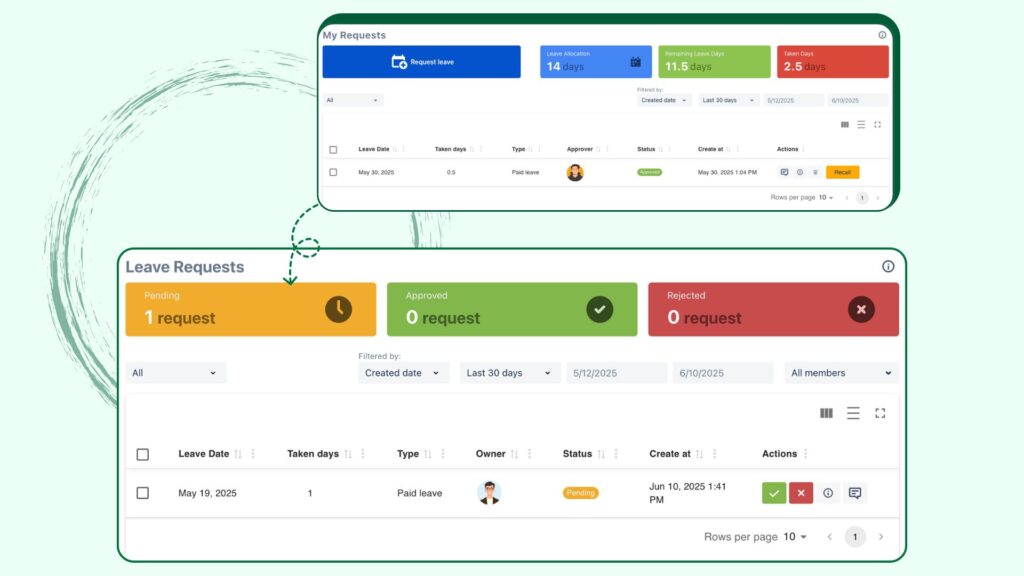
Rather than viewing leave in a vacuum, this solution treats it as a critical variable that determines your project’s total bandwidth. Additionally, the app allows teams to plan and track absences alongside scheduled work. So when a team member is unavailable, that information will reflect directly in capacity views and plans.
Key features:
- Capacity-based resource board: Automatically adjusts an individual’s “Maximum Capacity” (e.g., from 40 hours to 16 hours) based on approved leave to prevent accidental over-allocation.
- Billable vs. non-billable tracking: Links leave types to specific billing rates, allowing you to see the exact financial impact of paid leaves on your project budget.
- Skill-based allocation: When a team member is on leave, you can search for “replacement resources” based on specific skills (e.g., “Automation Tester”) to maintain project momentum.
Additionally, the app allows teams to plan and track absences alongside scheduled work. When a team member is unavailable, that information is reflected directly in capacity views and plans.
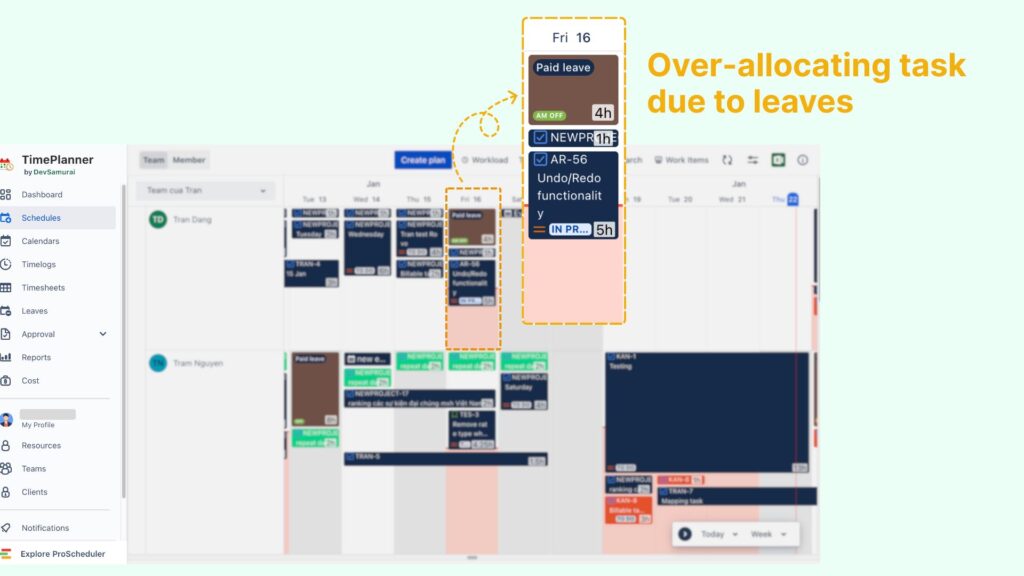
By combining work allocation and leave planning, TimePlanner helps managers answer critical questions:
- Do we have enough capacity for the next sprint?
- Who is over-allocated?
- How do absences impact delivery timelines?
Pros
- Combines leave management, time tracking, and resource planning
- Strong capacity visibility for sprint and project planning
- Helps prevent over-allocation and delivery risk
- Reduces reliance on multiple Marketplace apps
Cons
- More feature-rich than teams that need only basic time-off tracking
- Requires initial setup to unlock full planning value
2. UpRaise People
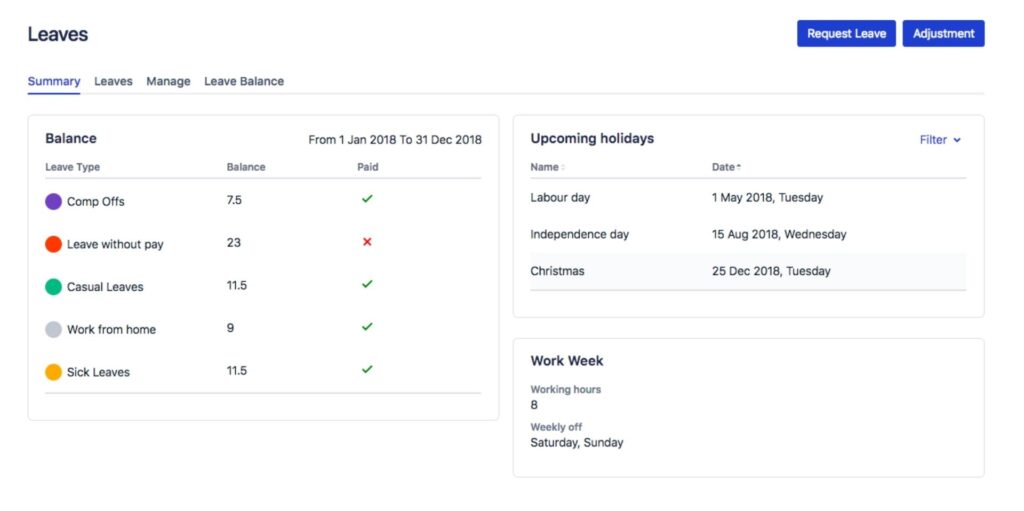
UpRaise People takes a more HR-centric approach to leave management within Jira. It is designed for organizations that want to manage employee information, organizational structure, and leave policies in a centralized way.
Key features:
- OKR and performance linkage: View how leave patterns impact a team member’s ability to hit their Key Results and project milestones.
- Punch-in approval engine: A new layer of accountability where time-off and work-logs require structured multi-level approvals for better audit trails.
- Advanced automation triggers: Automatically create Jira tasks or send Slack alerts based on leave status changes (e.g., “Auto-assign task to Lead when Senior is out”).
For managers overseeing larger or growing teams, UpRaise People provides a clear and consistent framework for managing people data alongside Jira work items.
Pros
- Strong HR-focused approach within Jira
- Centralized management of employee data and leave policies
- Suitable for growing organizations with structured processes
- Supports public holidays and approval workflows
Cons
- Can feel heavy for teams only needing time-off visibility
- Less focused on sprint capacity and delivery planning
- May introduce features some agile teams don’t actively use
3. Teamployees
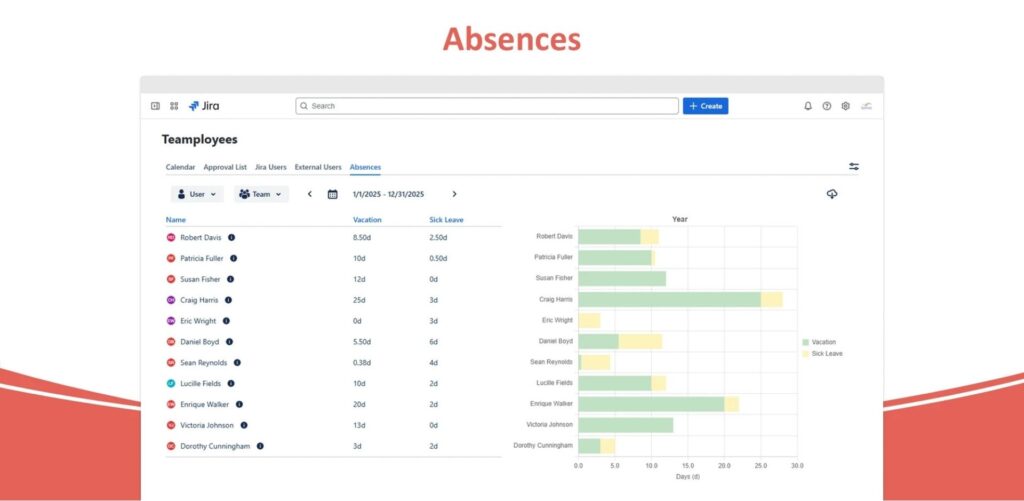
Teamployees is a “human-centric” management tool designed for global, remote, or hybrid teams. It focuses on visibility and transparency, ensuring that team leaders are aware of time zones and the social fabric of the team.
Key features:
- Presence and world clock gadgets: Dashboard elements that show you exactly who is online, who is on leave, and the current local time for your distributed team.
- Burnout trend analysis: Generates reports identifying “absence-deprived” employees, helping you proactively encourage leave to prevent long-term fatigue.
- Social and personal profiles: Tracks birthdays, work anniversaries, and hobbies alongside professional skills to build a more connected remote culture.
Pros:
- The most visually appealing interface on the market, encouraging high team engagement.
- Excellent for global teams managing multiple regional holiday calendars.
- Includes “Presence Status” so you know who is currently in a meeting or “Deep Work” mode.
Cons:
- Less focus on the “math” of resource capacity (e.g., hours and minutes).
- Does not integrate deeply with project-level budgeting or financial tools.
4. Leave Tracker
Leave Tracker by Alty Inc. focuses on simplicity and ease of use. The app also uses native Jira work items similar to TimePlanner and other leave management solutions to manage requests. It is perfect for team leaders who want a low-maintenance, reliable system that stays out of the way of the actual work.
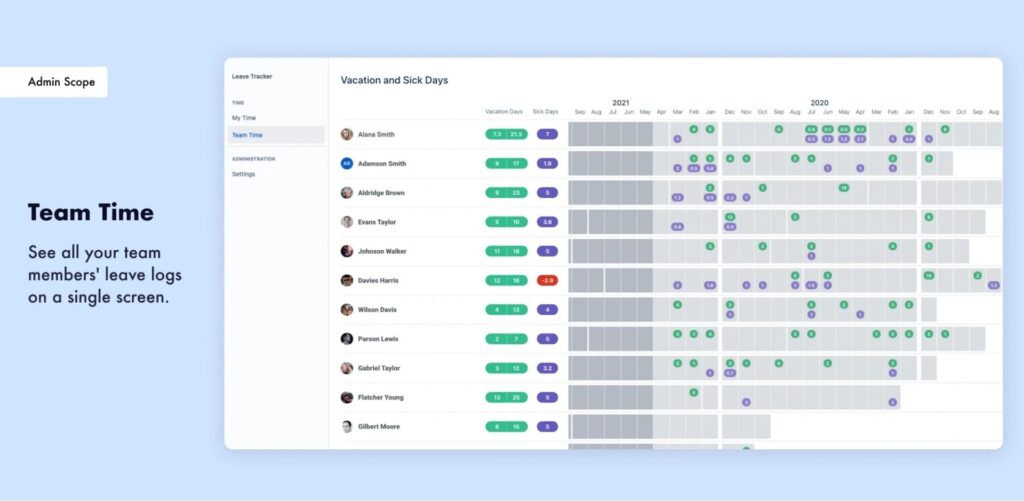
Leave Tracker by Alty Inc. is well-suited for teams that need straightforward leave tracking and want results quickly, without advanced planning or HR features.
Pros
- Simple and lightweight leave management solution
- Easy to set up and use with minimal configuration
- Clear team calendars for quick availability checks
- Ideal for small to mid-sized teams
Cons
- Limited reporting and planning capabilities
- Not designed for advanced resource or capacity management
- May not scale well for complex organizational structures
5. Smart Time-off for Jira
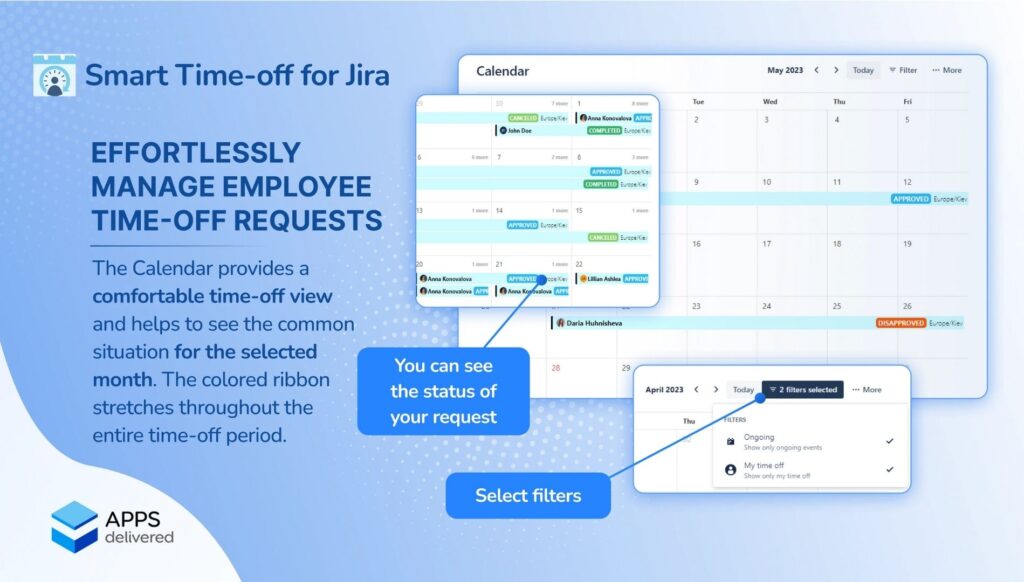
Smart Time-off for Jira is a modern, high-velocity solution that aims for communication among Jira leave management solutions. It is built for the “Slack-first” manager who needs to handle administrative tasks without ever leaving their primary communication channel.
Key features:
- One-click external approvals: Approve or deny requests directly from Slack or MS Teams notifications, no need to open Jira.
- Zero-data-access security: A unique architecture where your sensitive employee data stays within your local instance and is never stored on the vendor’s servers.
- Customizable time-off styles: Create visual, color-coded categories like “Offsite,” “Conference,” or “Family Emergency” for instant calendar clarity.
As a result, the app makes it easy for team members to request time off and for managers to approve and plan around absences without friction.
Pros
- Purpose-built for time-off and leave management
- Clean UI with fast user adoption
- Flexible leave types and approval workflows
- Works well for teams of various sizes
Cons
- Limited resource planning and capacity forecasting
- No built-in time tracking or delivery planning features
- Focused strictly on leave, not broader workforce management
What makes TimePlanner a better choice, for everyone
While many Jira Marketplace apps focus solely on managing time off, TimePlanner addresses a broader and more strategic challenge: how teams allocate time, manage capacity, and deliver work predictably. For project managers and team leaders, leave management is only one piece of the puzzle.
Additionally, understanding how available time is distributed across work items, projects, and teams is what ultimately enables confident planning.
1. Enhance time tracking at the work item level
TimePlanner allows teams to track work time directly on Jira work items, ensuring that time spent is closely tied to actual delivery activities. This work item-level time tracking provides accurate, real-world data on how long work takes, rather than relying on estimates alone.
Over time, this data helps teams refine planning assumptions, improve estimation accuracy, and better understand where capacity is being consumed. Meanwhile, for managers, this means planning is informed by evidence rather than intuition, reducing the risk of unrealistic commitments.
2. Capacity and resource planning with real availability
Unlike leave-only tools, TimePlanner combines time tracking data with planned absences to present a clear and realistic picture of team capacity. When a team member schedules time off, their available capacity is automatically adjusted across planning views.
As a result, this allows managers and leaders to see not just who is absent, but how much effective capacity remains for the team as a whole. Besides, this level of insight is particularly valuable during sprint planning and roadmap discussions, where overestimating availability can quickly lead to missed deadlines.
3. Visual workload distribution across teams and projects
TimePlanner provides visual planning views that allow managers to distribute work across teams and projects while accounting for availability constraints. Therefore, workloads can be balanced more effectively by identifying over-allocated individuals early and redistributing tasks before delivery is impacted.
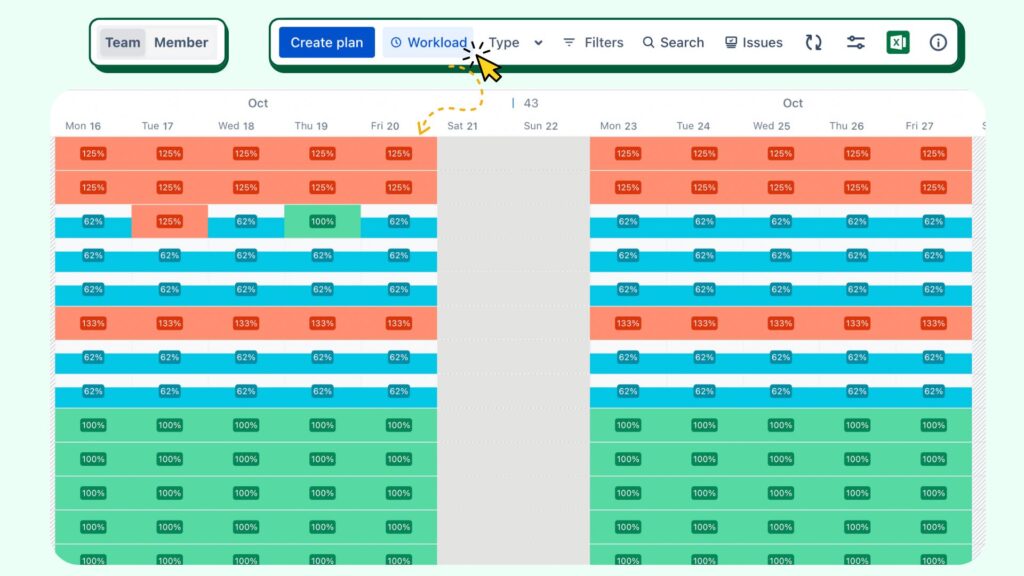
For team leaders, this supports proactive management rather than reactive firefighting when capacity issues arise mid-sprint.
4. Improve sprint planning and forecasting
By aligning planned work with actual available capacity, TimePlanner enables more reliable sprint planning. Teams can commit to work based on what they can realistically deliver, factoring in time off, ongoing work, and historical time usage.
In return, this reduces the likelihood of scope spillover and increases confidence in sprint goals.
From a forecasting perspective, TimePlanner helps managers assess whether upcoming milestones are achievable given current capacity trends.
Conclusion
Leave management is not just an administrative task—it directly affects team capacity, sprint commitments, and delivery outcomes. Since Jira does not offer native leave management, you can always look for leave management solutions from the Atlassian Marketplace to close this gap.
Whether your team needs simple time-off tracking, HR-oriented leave processes, or advanced resource planning, the right solution depends on how you plan and manage work.
For project managers and team leaders, the most effective leave management tools are those that make availability visible, reduce planning risk, and support confident, capacity-aware delivery.
The post 5 Best Jira Leave Management Solutions appeared first on TeamBoard – Resource planning, project management and Gantt Chart for Jira, monday.com.
Leave a Reply